
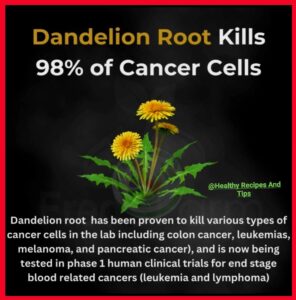
Dandelion Root and Cancer: Separating Promising Research from Hope
A striking claim has been circulating online: “Dandelion Root Kills 98% of Cancer Cells.” It’s a powerful, hopeful statement that captures the imagination and offers a natural solution to a devastating disease. But what is the science behind this headline, and what does it truly mean for cancer treatment?
Let’s delve into the research, separating exciting laboratory results from the current reality of medical treatment.
The Science Behind the Headline
The claim originates from serious scientific investigation, primarily from researchers at the University of Windsor in Canada. Studies in their lab, and others, have shown that extracts from dandelion root are indeed toxic to various human cancer cells in a petri dish.
The types of cancer cells that have shown susceptibility in these pre-clinical studies include:
· Colon cancer
· Leukemias
· Melanoma
· Pancreatic cancer
In these controlled laboratory settings, the extract was able to trigger a process called apoptosis, or programmed cell death, in a significant percentage of the cancer cells, sometimes reaching the high figures cited online.
The Crucial Caveat: “In the Lab” vs. “In the Human Body”
This is the most critical point to understand. Results from a petri dish (in vitro) do not automatically translate to a living, complex human body (in vivo). A substance can be highly effective at killing isolated cells in a lab but may not be absorbed correctly, may be broken down by the liver, or could cause severe side effects when introduced into a full biological system.
This is why the development of any new treatment, whether from a synthetic chemical or a plant extract, follows a rigorous, multi-phase process.
The Current Status: Human Clinical Trials
The image correctly notes that dandelion root extract is now being tested in human clinical trials. This is a significant and promising step forward. The ongoing trial at the University of Windsor is a Phase I clinical trial, which focuses primarily on:
1. Safety: Determining a safe dosage for humans.
2. Tolerability: Observing any side effects.
3. Pharmacokinetics: Understanding how the extract is processed by the body.
It’s important to note that this initial trial is specifically for patients with end-stage blood-related cancers (like leukemia and lymphoma) who have not responded to conventional treatments. The primary goal is not to prove efficacy yet, but to ensure it is safe for further, larger studies.
What Does This Mean For You?
While the research is undeniably promising, it is still in its early stages. Here is a balanced takeaway:
· There is Promise: The laboratory data is compelling enough to warrant further investigation by reputable scientific institutions. Dandelion root extract is a legitimate subject of oncological research.
· It is Not a Proven Cure: As of now, there is no conclusive evidence from large-scale human trials that dandelion root can effectively treat or cure cancer in people.
· Do Not Self-Treat: If you or a loved one is facing a cancer diagnosis, it is vitally important to rely on proven, evidence-based treatments. Do not abandon conventional therapy (chemotherapy, radiation, immunotherapy, etc.) in favor of unproven alternatives. Self-treating with dandelion root tea or supplements could be ineffective and dangerous.
· Consult Your Doctor: Always speak with your oncologist or healthcare provider before introducing any supplement, including dandelion root, as it could interact with medications or affect your treatment.
The Bottom Line
The story of dandelion root and cancer is a fascinating example of how modern science is exploring traditional remedies. It represents a beacon of hope and a potential avenue for future therapies. However, it is crucial to view this information with cautious optimism. The journey from a lab dish to a licensed medicine is long and complex, and dandelion root is still on that path.
For now, the best approach is to support continued scientific research while adhering to the proven treatment plans developed by medical professionals.