
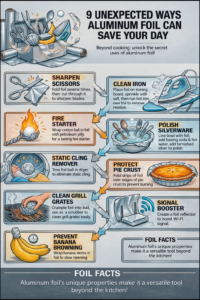
Aluminum foil is often treated as a simple kitchen staple—useful for wrapping leftovers or lining baking trays. But this thin, shiny sheet is far more versatile than most people realize. Beyond cooking, aluminum foil can help with cleaning, maintenance, organization, and even small emergencies around the home.
Below is a full, practical guide expanding on the ideas shown in the image, with clear explanations, tips, and safety notes.
1. Sharpen Scissors
If your scissors have gone dull, aluminum foil can help restore their edge.
How to do it:
- Fold a sheet of aluminum foil several times until it’s thick.
- Cut through the folded foil 8–10 times using the scissors.
Why it works: The foil acts as a mild abrasive, helping smooth out tiny nicks along the blade edge.
Best for: Household scissors (not professional or surgical scissors).
2. Clean an Iron
Burn marks and residue on irons are common, especially from synthetic fabrics.
How to do it:
- Place a sheet of aluminum foil on an ironing board.
- Sprinkle a small amount of salt over the foil.
- Run the warm (not hot) iron over the salt and foil.
Result: Residue transfers from the iron’s plate onto the foil.
Tip: Unplug the iron afterward and wipe with a damp cloth.
3. Fire Starter (Emergency Use)
Aluminum foil can help start a fire in survival or emergency situations.
How to do it:
- Place a small piece of foil under tinder (dry leaves, paper, or cotton).
- Use it to concentrate heat or reflect flame upward.
Why it helps: Foil reflects heat and can intensify warmth where it’s needed most.
⚠️ Safety note: Use only in controlled outdoor or emergency situations.
4. Polish Silverware
Restore shine to dull silverware without expensive cleaners.
How to do it:
- Line a bowl with aluminum foil (shiny side up).
- Add hot water and 1–2 tablespoons of baking soda.
- Place silver items in the bowl, ensuring they touch the foil.
What happens: A chemical reaction transfers tarnish from the silver to the foil.
5. Remove Static Cling
Static electricity can be annoying, especially in dry weather.
How to do it:
- Crumple a small ball of aluminum foil.
- Toss it into the dryer with your clothes.
Result: Foil helps discharge static electricity, reducing cling.
Bonus: Reusable and chemical-free alternative to dryer sheets.
6. Protect Pie Crusts from Burning
Over-browned pie edges are a common baking problem.
How to do it:
- Cut thin strips of aluminum foil.
- Loosely cover the pie’s crust edges before baking or halfway through.
Why it works: Foil shields the crust while allowing the filling to continue cooking.
7. Clean Grill Grates
Scrubbing grill grates doesn’t always require special brushes.
How to do it:
- Crumple aluminum foil into a tight ball.
- Use it as a scrubber on cooled (but still warm) grill grates.
Benefit: Removes stuck-on food and grease effectively.
⚠️ Always wear heat-resistant gloves.
8. Signal Booster (DIY Hack)
Aluminum foil can help improve signal direction for routers or antennas.
How to do it:
- Shape foil into a curved reflector.
- Place it behind a Wi-Fi router antenna or TV antenna.
Why it works: Foil reflects radio waves, helping focus signal strength in one direction.
Note: Results vary depending on setup and environment.
9. Prevent Banana Browning
Slow down ripening to reduce food waste.
How to do it:
- Wrap the stems of bananas tightly with aluminum foil.
Why it works: Foil limits the release of ethylene gas, which speeds ripening.
Foil Facts: Why Aluminum Foil Is So Useful
- Heat reflective – reflects up to 97% of radiant heat
- Malleable – easily shaped for countless uses
- Conductive – transfers heat and electricity efficiently
- Barrier – blocks moisture, air, and light
These properties make aluminum foil one of the most versatile tools you already own.
Final Thoughts
Aluminum foil is far more than a kitchen accessory. From cleaning and repairs to baking and emergency hacks, it’s a low-cost, multi-purpose tool worth keeping on hand.
Next time you reach for foil, remember—you’re holding one of the most underrated problem-solvers in your home.