
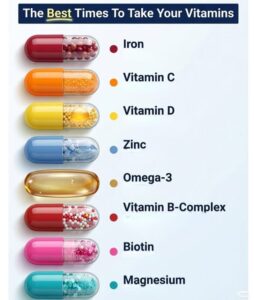
⏰ Best Time to Take Your Vitamins: A Complete Guide
Taking vitamins isn’t just about what you take—it’s also about when you take them. Timing can affect how well your body absorbs nutrients and how effective they are.
This guide explains the best time to take different vitamins, why timing matters, and how to avoid common mistakes.
🧠 Why Timing Matters
Vitamins are absorbed differently depending on:
- Whether they dissolve in fat or water
- Your metabolism
- Food intake
- Interactions with other nutrients
Taking vitamins at the wrong time may:
- Reduce absorption
- Cause stomach discomfort
- Interfere with sleep
- Cancel out benefits
🥗 Fat-Soluble vs Water-Soluble Vitamins
🟡 Fat-Soluble Vitamins
- Vitamins A, D, E, K
- Best absorbed with meals containing fat
🔵 Water-Soluble Vitamins
- Vitamin C and B-complex
- Can be taken on an empty stomach or with food
⏱️ Best Time to Take Each Vitamin
🌅 Morning (Best for Energy Vitamins)
Vitamin B Complex & Vitamin B12
Why morning?
- Boosts energy production
- Supports brain function
Take it:
- On an empty stomach or with breakfast
Avoid at night:
May interfere with sleep in some people.
Vitamin C
Why morning or midday?
- Supports immunity
- Enhances iron absorption
Take it:
- With or without food
- Split doses if high amount
🍽️ With Meals (Important for Absorption)
Vitamin D
Best time: Lunch or dinner
Why:
- Fat improves absorption
- Works better earlier in the day for some people
Vitamin A
Vitamin E
Vitamin K
Take together:
- With a meal containing healthy fats (olive oil, eggs, nuts)
🌙 Evening or Night
Magnesium (often paired with vitamins)
Why night?
- Promotes relaxation
- May improve sleep quality
Calcium
Best time: Evening (split doses if high amount)
Note:
Avoid taking with iron—they compete for absorption.
⚠️ Special Timing Considerations
Iron
Best time:
- Empty stomach (if tolerated)
Avoid taking with:
- Calcium
- Dairy
- Coffee or tea
Pair with:
- Vitamin C to improve absorption
Multivitamins
Best time:
- With breakfast or lunch
Why:
- Reduces nausea
- Provides energy throughout the day
🔄 Vitamins You Should NOT Take Together
Some nutrients compete or interfere with each other:
- Calcium ❌ Iron
- Zinc ❌ Copper (in high doses)
- Magnesium ❌ Calcium (large doses together may compete)
Spacing them out improves absorption.
🧾 Sample Daily Vitamin Schedule
Morning (Empty Stomach or Breakfast):
- Vitamin B Complex
- Vitamin B12
- Vitamin C
Lunch:
- Vitamin D
- Vitamins A, E, K
Evening:
- Calcium
Before Bed:
- Magnesium
⚠️ Common Mistakes to Avoid
- ❌ Taking fat-soluble vitamins without food
- ❌ Taking all supplements at once
- ❌ Taking iron with coffee or milk
- ❌ Taking energy vitamins at night
- ❌ Over-supplementing without medical advice
🧪 When Timing Matters Even More
If you have:
- Digestive issues
- Chronic illness
- Pregnancy
- Nutrient deficiencies like Anemia
…it’s especially important to optimize timing and consult a healthcare professional.
✅ Final Thoughts
The best time to take vitamins depends on the type of nutrient and your daily routine:
- Morning → Energy and water-soluble vitamins
- With meals → Fat-soluble vitamins
- Evening → Minerals for relaxation
Consistency matters more than perfection. Taking your vitamins regularly—at the right time—helps your body get the maximum benefit.